

How do I write text strings to SD card?
 Don M
Posts: 1,654
Don M
Posts: 1,654
I have this part of my program that stores hex data from 2 serial channels into a buffer and then to an sd card. The buffers are a 514 word buffer :
I then use pread to read out the data from the sd card (512 bytes) and store it into a word buffer then run the data from the word buffer through this code to get my print out on PST:
It produces an output like this:
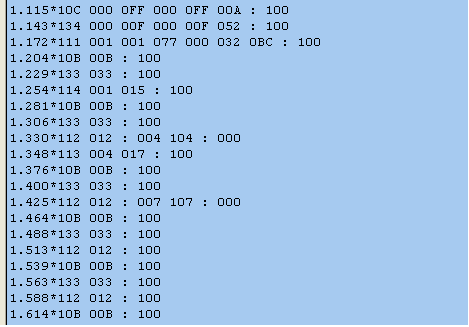
which is what I want. My question is how do I convert this data and store it on the SD card as a text file so that it can be read out in the same format as what is shown on PST?
  repeat
    repeat
      d := \ser1.rx_check                               ' d = serial channel 1
      if d <> -1                                        ' Look for data
        if c == 0                                       ' If RTC hasn't been reset...
          rtc.reset
          c := 1                                        ' Set so RTC won't be reset again
        if mrk == 0                                     ' If time stamp wasn't logged...
          if d <> $0000                                 ' Don't write time stamp to Master ACK's
            buf1[i] := (rtc.seconds | $B000)            ' Add seconds with $B000 mask
            i++
            buf1[i] := (rtc.millis | $A000)             ' Add milliseconds with $A000 mask
            i++
            mrk := 1                                    ' Time stamp is only logged once at beginning of Master command
        buf1[i] := (d | $8000)                          ' Write data from d to buffer and add $8000 mask
        i++
        repeat
          d := \ser1.rx_check
          if(d == -1)                                   ' If no data then flush
            ser1.rx_flush
            quit
      s := \ser2.rx_check                               ' s = serial channel 2
      if s <> -1                                        ' If data present...
        buf1[i] := (s | $4000)                          ' Write data to buffer with $4000 mask
        i++
        mrk := 0                                        ' Reset time stamp flag
      if i => 254                                       ' Watch index i
        i := 0                                          ' Reset i if true
        quit                                            ' Quit loop to write buffer to sd card
    sd.pwrite(@buf1[0], 512)                            ' Write 512 bytes to sd card from buffer
I then use pread to read out the data from the sd card (512 bytes) and store it into a word buffer then run the data from the word buffer through this code to get my print out on PST:
  repeat i from 0 to 255                                ' Repeat for 256 word buffer
    d := (block[i] & $F000)                             ' Mask for data logger flags
    case d
      $4000:                                            ' Serial 2 data
        s1 := 1                                         ' Set Serial 2 flag
        if m == 1                                       ' If data was preceeded by Serial 1 data...
          term.tx(58)                                   ' Print colon..
          term.tx(32)                                   ' and space
          m := 0                                        ' Reset Serial 1 flag so colon doesn't print again
        term.hex(block[i], 3)                           ' Print Serial 2 data
        if block[i] == $4100                            ' If Serial 2 data was an ACK..
          if s2 == 0                                    ' and no other Serial data was received..
            term.tx(13)                                 ' then CR for a new line
        else
          s2 := 1                                       ' If not an ACK
          m := 0
          term.tx(32)                                   ' then print space
      $8000:                                            ' Serial 1 data
        if block[i] == $8000                            ' Look for Serial 1 ACK
          if m == 0
            if s1 == 1                                  ' Look to see if this was a response to Serial 2
              term.tx(58)                               ' If so print a colon..
              term.tx(32)                               ' then a space...
              term.hex(block[i], 3)                     ' then the Serial 1 ACK..
              term.tx(13)                               ' then a CR for new line
              s1 := 0                                   ' Reset Serial 1 flag
          else
            term.hex(block[i], 3)                       ' If $8000 was not an ACK then just print it..
            term.tx(32)                                 ' and a space
        else
          if (block[i] & $0F00) == $0100                ' Look for no response from Serial 2...
            if m == 1
              term.str(string("** NO RESP **", 13))
          term.hex(block[i], 3)                         ' Print Serial 1 data
          term.tx(32)                                   ' and a space
          s2 := 0                                       ' Reset s2 flag
          m := 1                                        ' Set flag to look for Slave response
      $A000:
        term.decn((block[i] & $0FFF), 3)                ' Display milliseconds
        term.tx(42)                                     ' Print asterisk
      $B000:
        if (rtc.seconds) > 0                            ' Don't print seconds unless > 0
          term.dec(block[i] & $0FFF)                    ' Display seconds
          term.tx(46)                                   ' Print period
It produces an output like this:
which is what I want. My question is how do I convert this data and store it on the SD card as a text file so that it can be read out in the same format as what is shown on PST?
Comments
If you look at the internals of those methods, you see that at some point they call the "tx" method. That's where it has converted the next digit, and is ready to output it. When you copy the method into your program, you'll have to modify it so that it builds a string in memory instead of tx'ing it. Or, if you don't mind closely coupling it with the FSRW code, you can simply replace tx with a pputc option.
Here is how I would structure the function:
PUB dec(num) //copied version from Term or FDS+, with tx replaced by something like byte[str_addr++] := digit //Terminating zero byte[str_addr++] := 0 //Store the string (representing the number) to the SD card sdfat.pputs(str_base_addr)I don't know if this is in your scope, but there are example of doing this in the tutorials section of the propforth download archive.
You don't have to learn forth to get the jist of whats going on. It might provide some perspective on ways to 'git 'er done'.