

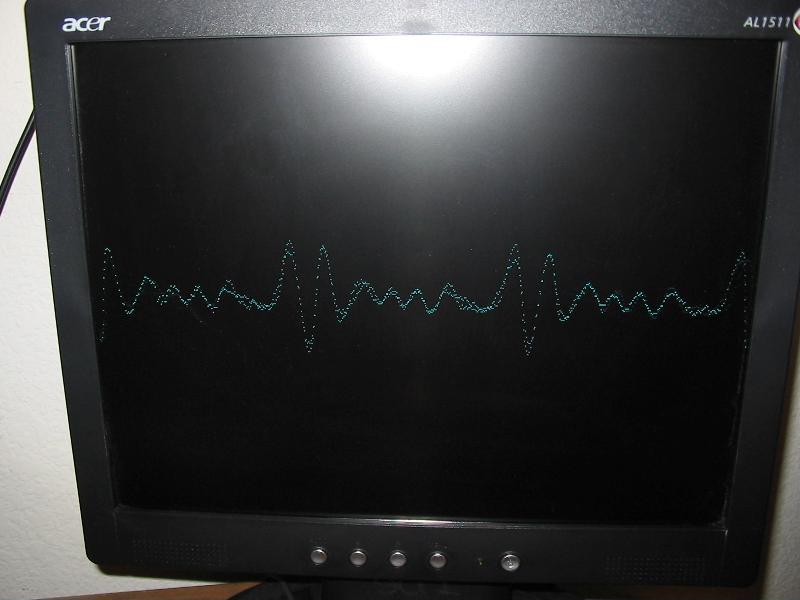
Scope Display (Microphone to VGA)
 cgracey
Posts: 14,323
cgracey
Posts: 14,323
This is for Propeller Demo Board Rev C's.
The microphone gets digitized and displayed on a VGA monitor like a scope trace, complete with auto-level triggering.
▔▔▔▔▔▔▔▔▔▔▔▔▔▔▔▔▔▔▔▔▔▔▔▔
Chip Gracey
Parallax, Inc.
Post Edited (Chip Gracey (Parallax)) : 6/9/2006 9:44:58 AM GMT
The microphone gets digitized and displayed on a VGA monitor like a scope trace, complete with auto-level triggering.
▔▔▔▔▔▔▔▔▔▔▔▔▔▔▔▔▔▔▔▔▔▔▔▔
Chip Gracey
Parallax, Inc.
Post Edited (Chip Gracey (Parallax)) : 6/9/2006 9:44:58 AM GMT

800 x 600 - 37K
Comments
'fill top line so that it gets erased by COG
longfill(@pixels, $FFFFFFFF, vga#xtiles)
▔▔▔▔▔▔▔▔▔▔▔▔▔▔▔▔▔▔▔▔▔▔▔▔
Just tossing my two bits worth into the bit bucket
KK
·
Chip Gracey
Parallax, Inc.
▔▔▔▔▔▔▔▔▔▔▔▔▔▔▔▔▔▔▔▔▔▔▔▔
Just tossing my two bits worth into the bit bucket
KK
·
Could you explain for me a quick question? How do I tell know where to actually wire the VGA pins? Is basepin the first line, y (16) then v (17) etc.? Just getting started, sorry if this is an obvious one...
PS, you would not believe how much I have searched just trying to get started on this....
Download the following schematic for the Parallax Demo Board:
http://www.parallax.com/Portals/0/Downloads/docs/prod/prop/PropDemoDschem.pdf
Simple D/A conversion for VGA from the Prop. I think that is what you are asking.
Jim
The downside of scrounging old bits is that you seldon get two idendical types of anything.
·Thats what· I thought.· Full speed ahead.